


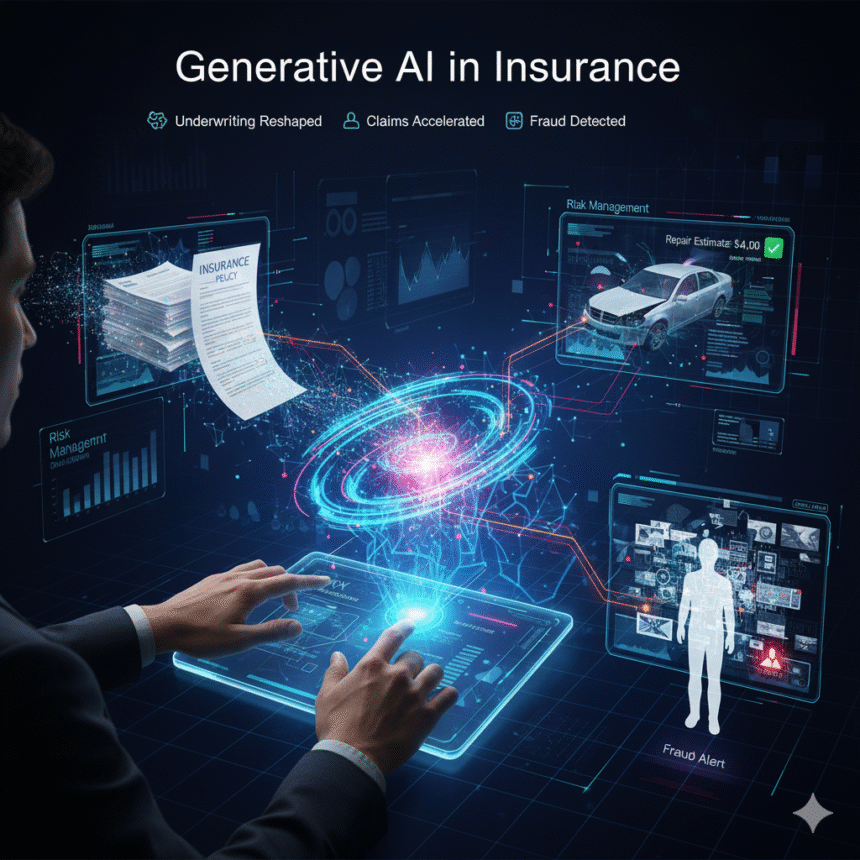
The insurance industry, historically built on data, risk modeling, and complex documentation, is currently undergoing one of its most profound transformations yet, driven by **Generative Artificial Intelligence (GenAI)**. Unlike traditional AI, which primarily analyzes and classifies existing data, GenAI creates new outputs—text, images, summaries, or even code—making it a revolutionary tool for automating judgment-heavy tasks across the entire insurance value chain.
For organizations navigating the complexities of global risk, GenAI is not just an efficiency tool; it is fundamentally altering the cost structure, speed, and accuracy of core operations, particularly in underwriting, claims management, and the crucial fight against fraud. This shift positions insurance as a proactive, rather than reactive, industry.
The New Engine for Underwriting Transformation
Underwriting is the most data-intensive process in insurance, often relying on massive volumes of **unstructured data**—everything from broker emails and legal documents to medical records and sensor data. GenAI, powered by Large Language Models (LLMs), excels here:
Automating Unstructured Data Extraction
GenAI can process and summarize lengthy, complex documents in minutes. For instance, an underwriter receiving a 500-page submission for a complex commercial risk can have GenAI generate a two-page summary highlighting key risk exposures, exclusions, and missing information. This radically accelerates the speed of quoting and policy issuance.
Enhanced Risk Modeling and Personalization
By ingesting diverse data sets, GenAI helps create more sophisticated **risk profiles**. It can synthesize data points to suggest highly personalized policy terms and pricing models that go beyond basic segmentation, leading to a fairer and more accurate transfer of risk.
Accelerating the Claims Cycle with Speed and Accuracy
Claims processing is where the value of an insurance policy is realized, yet it is often the slowest and most complex part of the customer journey. GenAI promises to slash cycle times and improve customer satisfaction dramatically.
Instant First Notice of Loss (FNOL) and Damage Assessment
In auto or property claims, computer vision models—a form of generative AI—can analyze photos or videos of damage submitted by the policyholder. These tools can automatically generate a preliminary repair estimate and categorize the severity of the damage almost instantly.
Summarization and Case Management
For complex liability or health claims, GenAI can analyze transcripts from calls, police reports, and witness statements, synthesizing all information into a coherent case summary for the human adjuster. This frees up adjusters to focus on complex decision-making rather than administrative tasks, moving claims from weeks to days.
The Frontier of Insurance Fraud Detection
Insurance fraud costs the industry billions annually. GenAI is becoming the most powerful weapon in the fight against sophisticated crime rings.
Training Models with Synthetic Data
One of the most revolutionary applications is GenAI’s ability to generate highly realistic **synthetic fraud scenarios**. These synthetic data sets can be used to train existing AI detection models to recognize novel patterns of fraud without compromising customer privacy or relying solely on historical (and potentially biased) fraud data.
Anomaly and Narrative Detection
GenAI analyzes the language used in claims narratives, police reports, and even social media to detect inconsistencies or patterns that deviate from typical, non-fraudulent claims. It can flag subtle linguistic cues that suggest collusion or misrepresentation, making it an advanced form of **anomaly detection** for text-based evidence.
The Need for Ethical and Regulatory Vigilance
While the benefits are immense, the deployment of GenAI is not without risks. Insurance firms must actively address key challenges:
- Data Privacy: Ensuring that LLMs are trained and deployed in compliance with strict data protection regulations (like GDPR) is paramount.
- Model Bias: If GenAI is trained on historical data that reflects past societal biases (e.g., pricing certain risks differently based on protected characteristics), the models may perpetuate and amplify this bias, leading to unfair outcomes.
- Explainability: As GenAI decisions become more complex, the ability to clearly explain a denied claim or an aggressive pricing decision to a regulator or customer is critical.
In conclusion, Generative AI is rapidly moving from an experimental concept to a foundational technology in insurance. It promises to transform the industry from a manually intensive processor of risk into a highly automated, predictive, and customer-centric financial service, enabling a faster, fairer, and more effective global risk transfer market.